
Stories of Vienna

I have not been able to get Gustav Mahler’s name out of my head since the day I read this quote of his:
“Tradition is not the worship of ashes, but the preservation of fire.”
—Gustav Mahler
Last Saturday, I could not help but take a photo of myself with his commemorative bust at the Vienna Opera House. I knew Gustav had something to do with music. I had no damn clue what. I just took a picture because he had a great quote.
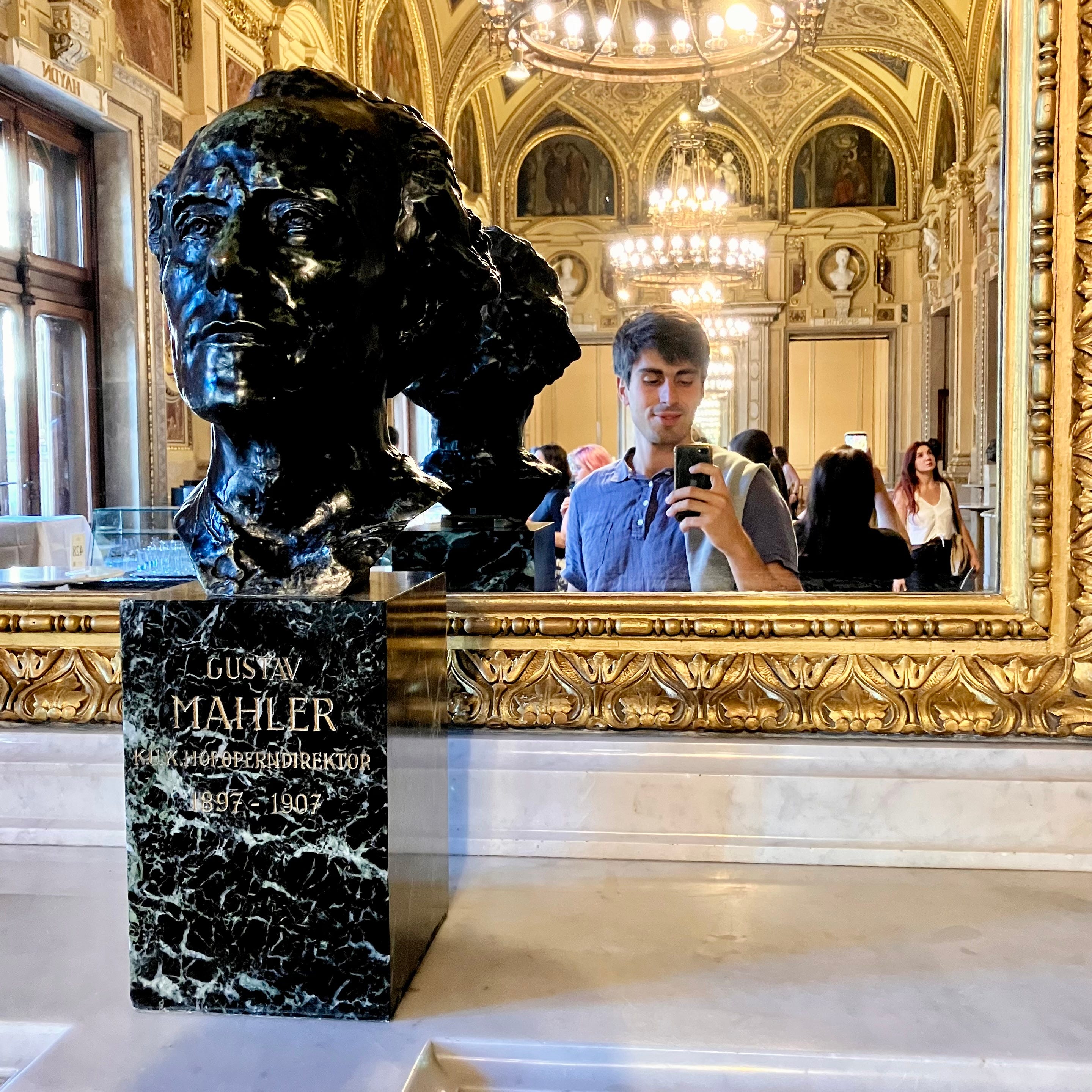
Watching my eagerness to immortalize a moment with Gustav Mahler, I can just picture any random Viennese guy —the kind who has loved opera since he was a twinkle in his father’s eye, holds a stalls ticket that costs over €200 and thinks it is a total steal, and would score an 11 out of 10 if his style were judged by the venue’s traditional dress code— telling me: “What? You like Mahler? His [insert Mahler’s best symphony] symphony is delightful, don’t you think?”
It would be hilarious to see his reaction when I told him that, for me, my favorite thing about Mahler is a single quote. It would be like any expat occupying Barcelona telling me that the only thing they know —and, at the same time, love most— about Gaudí is his maxim: “First love, then technique.” The sheer embarrassment that this hypothetical situation caused me led me to try and learn a bit more about the figure of Gustav Mahler.
And then, the magic happened. Yes: I found another one of those quotes that slaps you right in the face with your own stupidity, because it delivers a massive explanation in the simplest way possible. It goes like this:
“What is best in music is not to be found in the notes.”
—Gustav Mahler
Pretty great, right? What makes music special is not found in what, to us ignoramuses, are its building blocks. However, I did not truly grasp the quote until —finally!— I understood Mahler’s figure on a slightly less superficial level.
When Gustav was appointed director of the Vienna Opera —the equivalent of a football manager being named Barça’s coach— what would have been a source of pride and satisfaction for many was a total headache for him: it got in the way of his true calling as a composer. He was not happy standing in front of the orchestra; his moments of pure joy were found in his leisure time, locked away in his apartment on Wipplingerstrasse, playing with his full creative potential. Putting notes on score sheets. (What a joke. Keeping with the previous analogy: as if Gaudí were just piling up bricks.) No. Mahler loved composing music —which is not the same as putting notes on score sheets.
But weeds do not exist and things happen for a reason: by serving as a director, Gustav experienced musical tradition by discovering the fire and brushing away the ashes when it came to crafting his own compositions. He composed highly controversial works that took time to win the approval of mediocrity.
Mahler was also a relentless perfectionist from birth. With a crystal-clear musical vision. What he could not express in words, he said through his musical compositions. Scores that had rhythms, notes, tempos... and countless annotations along the margins, describing something he desperately needed to convey but that the constraints of the musical scale language would not allow.
This was not exclusive to Mahler. Or maybe it was. Other composers, for the sake of those performing the symphonies, would write words in the margins like “allegro”, “andante”, “forte”, or “crescendo”. Mahler, sometimes for the performers and sometimes for himself, would write:
“The entire piece delicate and flowing throughout! No fortissimo! No dragging!”
“Slow. Dragging. Like a sound of nature.”
“With parody.”
“Stormily moving.”
“Like a bird song.“
“Bird’s voice, bird call.“
“Dying away, allow to die away.“
“Imperceptibly pressing forward.“
“Don’t rush; don’t even think about rushing.”
“Occupy the place ‘in the distance’.”
“Carried by the wind.”
“With humor.”
“With the greatest unfolding of power.”
“All at once somewhat heavier.”
“Passionate but tender.”
“Always very flowing.”
“Always still imperceptibly holding back.”